
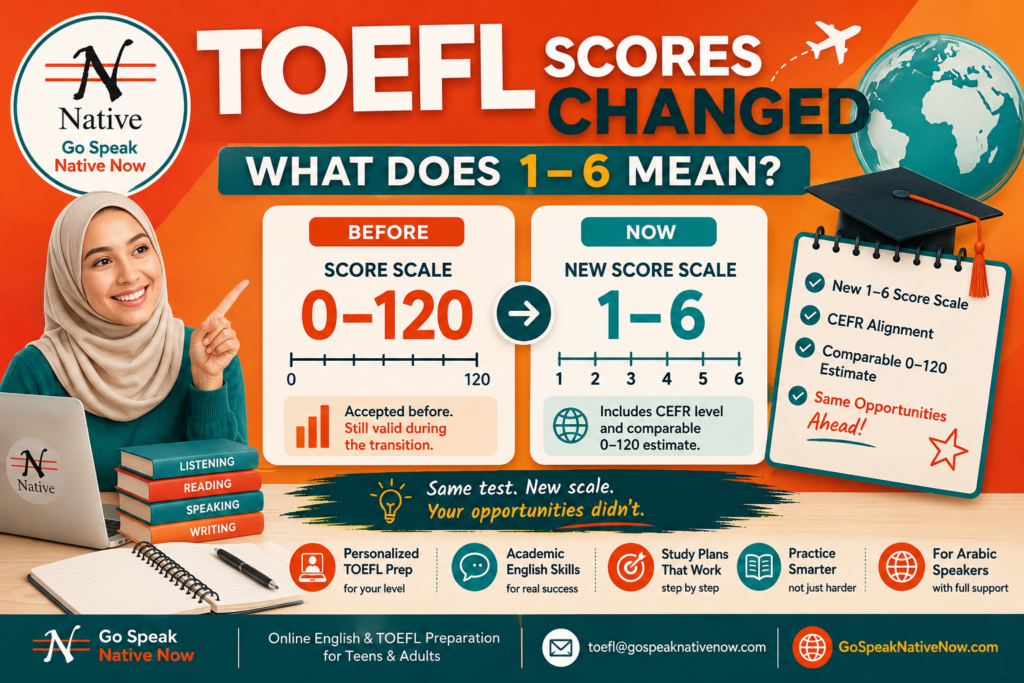
TOEFL Scores Have Changed: Understanding the New 1–6 Score Scale
Have you checked a university website and noticed that it still asks for a TOEFL score such as 80, 90, or 100?
Then you looked at the updated TOEFL information and saw scores from 1 to 6?
Do not panic. The TOEFL score display has changed, but your ability to use your results for university applications has not.
As of January 21, 2026, TOEFL iBT score reports use an updated scale from 1 to 6, including half-point scores such as 3.5, 4.5, and 5.5. Students receive a score for Reading, Listening, Speaking, Writing, and an overall score.
Why did TOEFL change its score scale?
The updated scale is designed to make TOEFL scores easier to understand alongside the Common European Framework of Reference for Languages, commonly called the CEFR.
The CEFR describes English ability using levels from A1 to C2:
- A1 and A2 represent basic English proficiency
- B1 and B2 represent intermediate to upper-intermediate proficiency
- C1 and C2 represent advanced proficiency
The new TOEFL score scale connects more directly with these internationally recognized proficiency levels.
Here is the general relationship:
| TOEFL score | CEFR level |
|---|---|
| 6 | C2 |
| 5 to 5.5 | C1 |
| 4 to 4.5 | B2 |
| 3 to 3.5 | B1 |
| 2 to 2.5 | A2 |
| 1 to 1.5 | A1 |
What happened to the 0–120 TOEFL score?
The familiar 0–120 score has not suddenly become useless.
During the transition period through January 2028, official TOEFL iBT score reports include:
- The new overall and section scores from 1 to 6
- The student’s CEFR proficiency level
- A comparable overall score estimate on the 0–120 scale
This means students do not need to calculate or convert their scores themselves.
Why do some universities still show 0–120?
Universities are updating their admissions websites and internal systems at different speeds.
During this transition, you may find:
- One university using the 0–120 scale
- Another university using the 1–6 scale
- Some universities showing both formats
Seeing the older score format on a university website does not automatically mean the information is invalid or that the university no longer accepts TOEFL. Your official score report provides both formats so institutions can evaluate your application during the transition.
How do common university requirements compare?
ETS provides the following general guidance for institutions moving from the previous scale to the updated scale:
| Previous requirement | Updated score requirement |
|---|---|
| 100 | 5 |
| 90 | 4.5 |
| 80 | 4 |
| 70 | 3.5 |
These figures are useful for understanding common admissions requirements, but they should not be treated as a personal score calculator. A score band can correspond to a range of results on the previous scale. For example, a score of 5 generally aligns with a previous total-score range beginning at 95.
Always check the exact requirements of the university, scholarship program, licensing authority, or employer to which you are applying.
How is the new overall TOEFL score calculated?
Under the new system, your scores from the four test sections are averaged:
- Reading
- Listening
- Speaking
- Writing
The average is then rounded to the nearest half-point band.
For example, an average of 5.25 becomes an overall score of 5.5. This differs from the previous system, where the four section scores were added together to produce a total out of 120.
Do you need to convert your TOEFL score?
No.
Your official TOEFL iBT report already shows the updated score and a comparable 0–120 total score estimate. You can compare the format requested by the university with the information shown on your report.
Before applying, follow these steps:
- Check the university’s official English-language requirements.
- Confirm whether it lists a total score, minimum section scores, or both.
- Check whether the stated requirement applies to tests taken before or after January 21, 2026.
- Contact the admissions department when the wording is unclear.
- Submit your official score report according to the university’s instructions.
Has TOEFL acceptance changed?
No. The score display changed, but TOEFL remains widely accepted by universities and institutions around the world. The new format is intended to make scores easier to interpret internationally, not to reduce the value of the test.
Preparing for your target TOEFL score
Understanding the scale is only the first step.
A strong TOEFL preparation plan should help you develop all four tested skills:
- Reading academic and everyday English
- Understanding conversations, announcements, and academic talks
- Speaking clearly and confidently
- Writing accurate sentences, emails, and academic responses
Your target score should be based on the requirements of the institutions you plan to apply to, not simply on what someone else considers a “good” score.
Get help preparing for TOEFL
Go Speak Native Now provides personalized online English and TOEFL preparation for teens and adults, with support especially suited to Arabic-speaking learners.
Preparation may include:
- English-level assessment
- Personalized study planning
- Reading and listening practice
- Speaking confidence and fluency
- Grammar and vocabulary development
- Writing feedback
- TOEFL task practice
- University score-requirement guidance
Ready to begin preparing for TOEFL?
Contact us at:
Your score format may have changed, but your academic goals are still within reach.